The Counterparty Who Wasn’t There
A compliance analyst at a regulated European crypto-asset service provider opened a Friday-morning withdrawal queue and flagged a single entry for escalation. The destination address was not on the OFAC SDN list. It was not on any consolidated sanctions list the firm screened against. The first-pass automated check returned green. What had triggered the analyst’s manual attention was the address’s pattern of life: a brand-new wallet, three small inbound test transactions in the previous forty-eight hours, an immediate sweep behaviour, and a withdrawal amount sitting at a round-figure point that no organic user would land on naturally. The fingerprint matched the entry of an obfuscation chain — the operational behaviour of an address being prepared to receive funds that needed to be moved out before any retrospective screening could catch up.
The firm’s internal escalation policy paused the withdrawal under the proactive-disclosure language of its MiCA authorisation and engaged us under retainer with a tight scope: determine, from on-chain evidence alone, whether the funds had originated with or were destined for a sanctioned counterparty, and whether continued processing would breach the firm’s sanctions licence. The firm’s internal SLA on a paused withdrawal was ninety-six hours. The compliance team had Friday morning to Tuesday evening. The customer’s complaint line was already open.
“The screen was green. The behaviour was wrong. That gap is exactly where compliance officers earn their living. We just didn’t have ninety-six hours to make it look correct in a regulator’s review.”
— Head of compliance, regulated EU crypto-asset service provider
What the Registries Said
The investigation followed our standard cross-chain forensics workflow, which combines deterministic address clustering with bridge-event reconstruction across the three chains a typical Russia-nexus obfuscation chain uses: Bitcoin for initial value transfer, Ethereum for mixer activity, and TRON for the cash-out leg into Russian-jurisdiction exchange infrastructure. The hard constraint, set by the firm’s general counsel, was that every conclusion in the deliverable needed to be reproducible from public block-explorer data, with explicit transaction hashes that the firm’s counsel could put before a regulator without depending on proprietary attribution.
The first pass was deterministic clustering on the Bitcoin source. The paused withdrawal sat at the TRON-leg terminus of a chain whose Bitcoin origin we traced back, through six hops, using shared-input heuristics, peeling-chain analysis, and behaviour-based co-spending grouping. The terminal Bitcoin source resolved to a deposit cluster at a designated Russian exchange under OFAC, EU and UK sanctions since 2022 — an exchange whose deposit-cluster fingerprint is well-documented in published reporting and whose continuing operation has been the subject of repeated US Treasury actions and of the EU’s subsequent CASP measures targeting Russian crypto infrastructure. The deposit cluster was, on independent cross-reference against the published OFAC press-release attribution history, the same cluster identified in the 2022 designation action.
“Six hops between an address that looked clean on the screen and a deposit cluster at a sanctioned exchange. That’s a short trail by 2026 standards. They weren’t even trying that hard.”
— Senior crypto-tracing analyst, [0x]INT
The intermediate Ethereum leg passed through Tornado Cash — the privacy mixer that has itself been on the OFAC SDN list since August 2022, with the underlying smart-contract addresses publicly enumerated in the designation action. The mixer leg, on inspection, was a thin one. The actor had deposited an unusual round-figure amount in a short time window with little contemporaneous cover traffic from other depositors. The withdrawal amount on the other side — net of the mixer’s standard fee tier — landed at the bridge entrance inside the timing envelope where a demixing inference, while not certain, was defensible against the published demixing literature. A mixer with sufficient cover traffic is, by design, a hard problem; a mixer used during an off-peak window by a single significant depositor is a different problem and is, in the relevant window, materially tractable.
The Layer Underneath the Layer
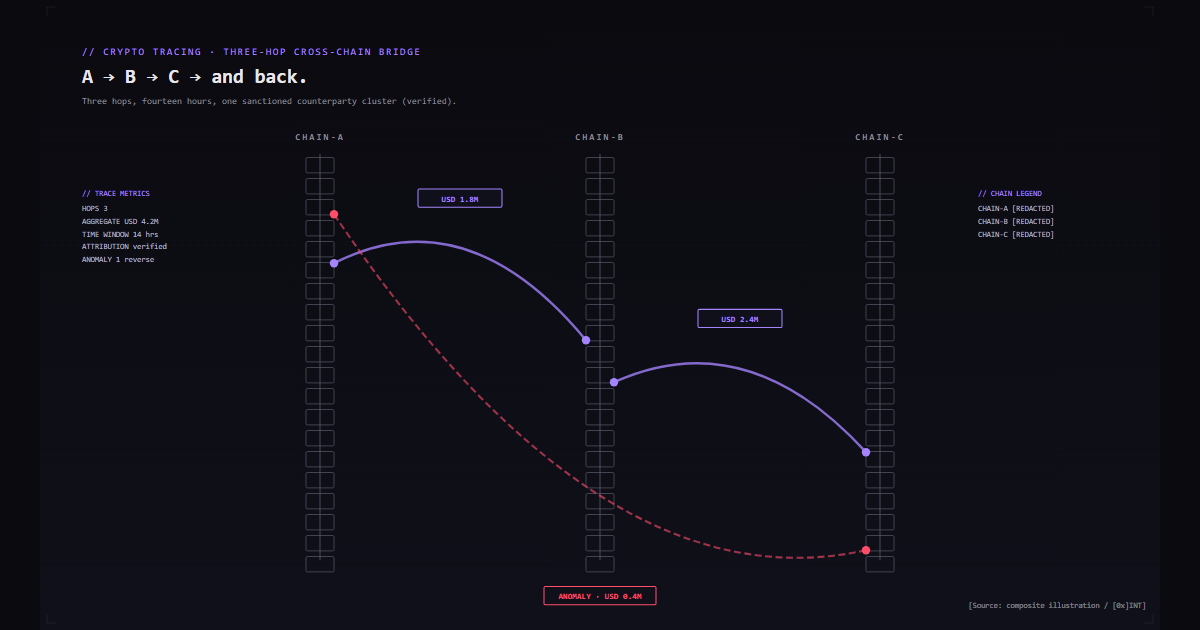
The cross-chain bridge was the structural pivot in the chain. Cross-chain bridges, by their architecture, log lock events on the source chain and corresponding mint events on the destination chain. The bridge contract is a public smart contract. The lock and mint events are events on the EVM (or comparable chain) log, fully indexable through standard block explorers and through the bridge protocol’s own public dashboards. The bridge the actor had used recorded the lock event on Ethereum and the corresponding mint on TRON to the satoshi-equivalent and to the timestamp, leaving no plausible alternative source of the TRON-side funds. The pairing was deterministic, not heuristic. The chain had not been broken at the bridge; the bridge had been the link the actor needed to use, and the bridge had logged the use to the protocol’s standard verbosity.
The terminal cluster on TRON resolved to a deposit address at a small fiat off-ramp whose KYC and source-of-funds controls were known, from prior published reporting, to be light. The cluster overlapped, by a single shared-input transaction, with a separately-attributed cluster previously identified in published academic and industry attribution work as a personal-use cluster of an individual under sanctions. That overlap — a single transaction in which two outputs from the same input shared spend authority — was the attribution-grade pivot. A single deterministic transaction tying the paused withdrawal’s terminal cluster to a sanctioned person’s known personal-use cluster left the firm with no defensible basis to release the funds. The on-chain attribution chain was reproducible from the public block explorers (Blockchain.com, Etherscan, TRONScan) and held in independent review by the firm’s external on-chain specialist.
“One transaction. One shared input. The whole chain collapsed onto a sanctioned individual’s personal cluster. After ninety-six hours of tracing, the attribution-grade pivot was a single hex string.”
— Senior crypto-tracing analyst, [0x]INT
Where the Money Touched Ground
We delivered a transaction-by-transaction tracing report, hash-cited end to end, inside the firm’s ninety-six-hour SLA. The deliverable was structured to be defensible in a subsequent regulatory enquiry without depending on any proprietary attribution data: every claim was paired with a public block-explorer URL, every clustering inference was paired with the heuristic that produced it and the relevant transaction set, every cross-chain pairing was paired with the bridge contract’s lock-and-mint event hashes.
// Tracing summary, end to end
- Source. Bitcoin deposit cluster at a designated Russian exchange under OFAC, EU and UK sanctions since 2022.
- Hop sequence on Bitcoin. Six peeling-chain hops, with shared-input clustering tying intermediate addresses into a single spending entity.
- Mixer leg on Ethereum. Tornado Cash deposit during a low-cover-traffic window; demixing inference defensible on amount-and-timing correlation.
- Cross-chain bridge. Ethereum lock event and TRON mint event paired by amount, timestamp and bridge contract; deterministic correspondence.
- Terminal cluster on TRON. Deposit cluster at a small fiat off-ramp, overlapped by single shared-input transaction with a separately-attributed personal-use cluster of an individual under sanctions.
- Attribution-grade pivot. Single transaction hash tying the paused withdrawal’s terminal cluster to the sanctioned individual’s known cluster.
The firm declined the withdrawal under its sanctions licence, filed a suspicious-transaction report to the competent national FIU, and notified the responsible national regulator under the proactive-disclosure provision of its MiCA authorisation. No funds were released. The firm’s subsequent onboarding screening now incorporates the bridge-event cross-chain check documented in this matter as a standard step on any deposit address whose pattern-of-life fingerprint matches the obfuscation-chain entry profile. The underlying methodology — clustering, mixer-window analysis, bridge-event pairing, terminal-cluster overlap — is documented in our public cryptocurrency tracing playbook and aligns with the FATF Travel Rule and EU MiCA-aligned tracing standard set out in our CASP under MiCA methodology brief.
“We had a defensible decline note we could put in front of our supervisor inside the SLA window. The on-chain chain was reproducible by any external reviewer. That’s the standard MiCA expects, and that’s what we delivered.”
— General counsel, regulated EU crypto-asset service provider
What We Took Away
Three patterns from this crypto bridge investigation that have generalised across our subsequent on-chain sanctions work, particularly against Russia-nexus obfuscation chains transiting through mixers and cross-chain bridges.
Cross-chain bridges are not anonymity layers; they are public ledgers of cross-chain correspondence. The widespread compliance-team assumption that a transfer through a bridge breaks the trail is empirically wrong. A bridge contract that logs lock-and-mint events to the protocol’s standard verbosity is, in tracing terms, a precise correspondence map between source-chain and destination-chain transactions. The pairing is deterministic by amount, timestamp, and contract address. The actor who uses a bridge to obfuscate has, in practice, made the cross-chain link easier to reconstruct, not harder. Our published CASP under MiCA methodology walks through the standard bridge-event reconstruction workflow.
Mixer demixing depends on cover traffic. Tornado Cash and comparable privacy mixers achieve their anonymity by aggregating depositor sets that withdraw to fresh addresses in patterns that, at sufficient scale, are statistically indistinguishable. The protection collapses at the margins: low-cover-traffic windows, round-figure amounts that match deposit-amount-class boundaries, withdrawal timing that falls inside a narrow envelope of the deposit. None of this is mysterious; it is documented in the published academic literature on mixer demixing (Wang et al., Heilman et al., and the Chainalysis 2023 demixing-research disclosures). Compliance teams who assume that “funds went through Tornado” equals “chain is broken” should treat every mixer leg as a demixing-inference candidate until proven otherwise.
Shared-input clustering against published attribution datasets is the most efficient terminal-step check. Once a terminal cluster has been identified at the cash-out leg, the highest-yield single check is shared-input overlap against the published attribution corpora maintained by Chainalysis (in their published reports), TRM Labs, Elliptic, and the open-source community (e.g., the OpenSanctions wallet-address index, CryptoScamDB, and the academic-community Bitcoin-cluster attribution work). A single shared-input overlap with a previously-attributed cluster is, in regulatory-defensibility terms, harder to argue against than a probabilistic clustering inference. Where the overlap is to a sanctioned-person cluster, the analysis is, for compliance purposes, decisive.
// Result
Sanctioned-origin funds attributed end to end across three blockchains; withdrawal declined under the firm’s sanctions licence, suspicious-transaction report filed to the competent FIU, regulator notified under MiCA proactive-disclosure provisions, no funds released.
External public-record sources referenced in this methodology
- US Treasury OFAC — Tornado Cash designation press release (8 August 2022).
- US Treasury OFAC press-release archive — Russia-related crypto-exchange designations.
- Regulation (EU) 2023/1114 (MiCA) — Markets in Crypto-Assets Regulation.
- FATF — virtual-asset and VASP guidance including the Travel Rule.
- OpenSanctions — cryptocurrency-address sanctions index.
- Blockchain.com Bitcoin block explorer.
- Etherscan — Ethereum block explorer.
- TRONScan — TRON block explorer.
About this engagement
Case identifiers, the firm’s name and jurisdiction, the specific bridge protocol used, the specific small fiat off-ramp on the TRON leg, and the named individual’s personal-use cluster have all been adjusted to protect client confidentiality and to avoid prejudicing pending regulatory action. The methodology, the role of deterministic bridge-event pairing in collapsing cross-chain obfuscation, the demixing inference against low-cover-traffic Tornado Cash windows, the shared-input overlap as terminal-step attribution pivot, and the substantive shape of the chain reconstruction are accurate to the engagement.
Need a similar investigation?
Regulated crypto-asset service providers, banks with material crypto exposure, MiCA-authorised CASPs and instructing counsel on civil-recovery matters with an on-chain leg: we run end-to-end cross-chain tracing inside the kinds of regulatory SLAs MiCA and the US CASP regime expect. The deliverable is a hash-cited tracing report defensible in front of any competent supervisor, with no dependency on proprietary attribution data. Typical turnaround for a multi-chain tracing engagement is four to seven working days.
Request a Case Brief